1528
Mitchell Maccorkill of Kilmarnock
Assigned lands at Myltoune, Ayrshire. The earliest Lowland record of the name.
Register of the Monastery of Cambuskenneth
They were neither princes nor landed gentry, but tenant farmers, tradesmen and a few merchants. They came from Ayrshire and the Clyde with the Plantation, settled the Laggan, Burt and Inishowen, and left a thin trail of muster rolls, hearth taxes and kirk session entries that this site follows from 1630 to the 1901 census.
Few families of tenant farmers left much behind. These are the surviving landmarks, each discussed in full in its chapter.
Assigned lands at Myltoune, Ayrshire. The earliest Lowland record of the name.
Register of the Monastery of CambuskennethMustered with sword and pike among Lady Katherine Cunningham's men, Barony of Raphoe.
Muster Roll, Co. DonegalLt Col. Robert Galbreith's company, Sir Audley Mervyn's regiment of the Laggan Army, mustered at Elagh.
PRONI muster, 20 July 1643Buried in the grounds of St Columb's Cathedral, Derry.
St Columb's Cathedral registerHouseholder in the Laggan near Newtowncunningham. James follows him in 1665.
Hearth Money Rolls, Co. DonegalThe first of the McCorkell baptisms in one of the region's few surviving early Presbyterian records.
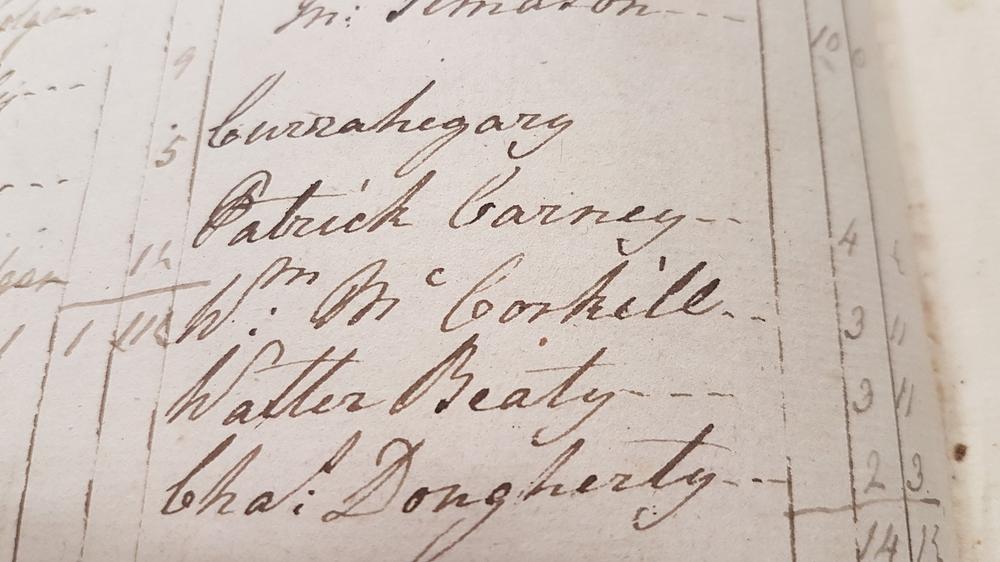
Burt Kirk Session BookIn Templemore and Burt, Moville, Clonca and Cumber, placing the family in their townlands for the first time in a century.
Protestant Householders' CensusPays county cess in Moville Upper, serves as churchwarden, and signs the vestry minutes as "William Corkle". The earliest proven ancestor of the Ballyrattan line.
Moville parish vestry book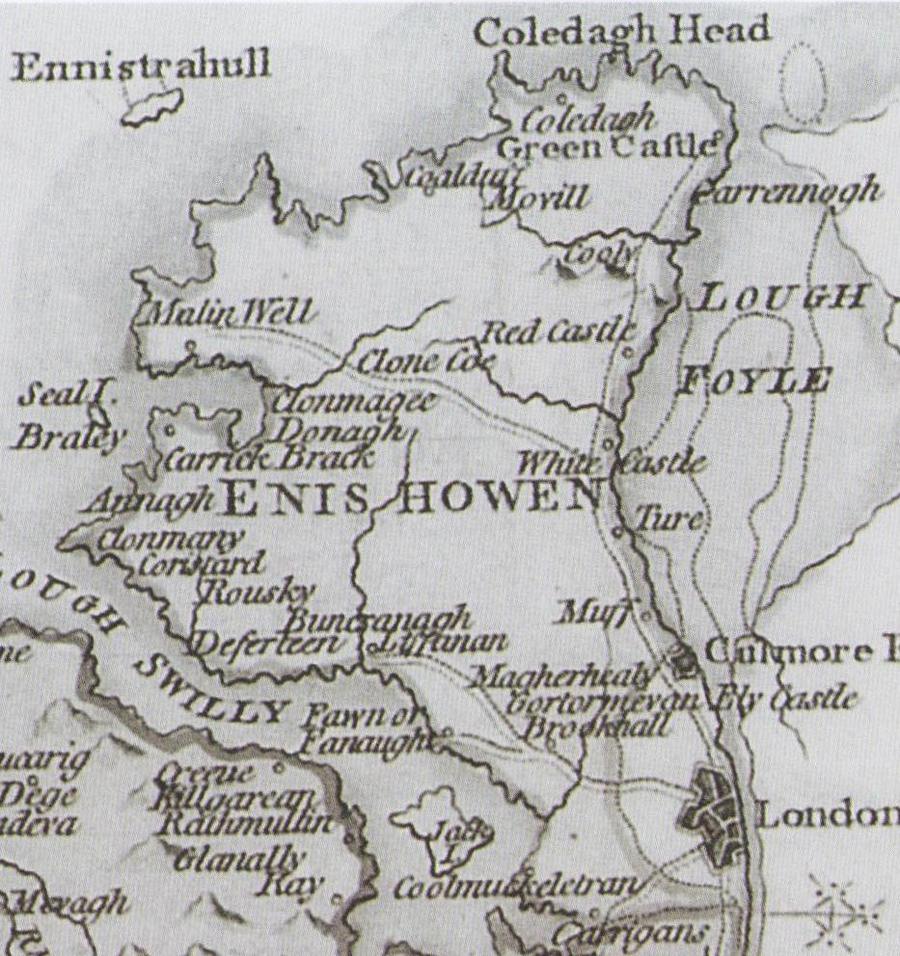
Male McCorkells pass down an almost unchanged Y chromosome. Testers from Donegal, Northern Ireland, Pennsylvania and the Carolinas share one paternal line, and Big Y results have now placed it precisely on the human family tree.
The McCorquodales of Argyll and the Corkills of the Isle of Man carry a name from the same Norse root, Thorketill. Their Y-DNA belongs to haplogroup I, an entirely different branch from ours. The names are related; the families are not.
Our nearest deep cousins are Lowland and Border names. That fits the documentary trail from Kilmarnock in 1528 to the Cunningham estates of the Laggan in 1630.
By 2015 fewer than ten McCorkell families remained in the county, four of them on townlands their ancestors had farmed for over 300 years.
This site grows out of Ulster McCorkells, which I started in 2009 as a home for every record of the name I could find in Ireland, and its companion site Donegal McCorkells, for my own family. Over the years they were visited by McCorkells, McCorkles and MacCorkills from America, Canada, Australia, New Zealand and Scotland. Many of those visitors wrote to me, and their letters, trees and photographs are now part of this study. If you found your way here from one of the old sites, welcome back.